
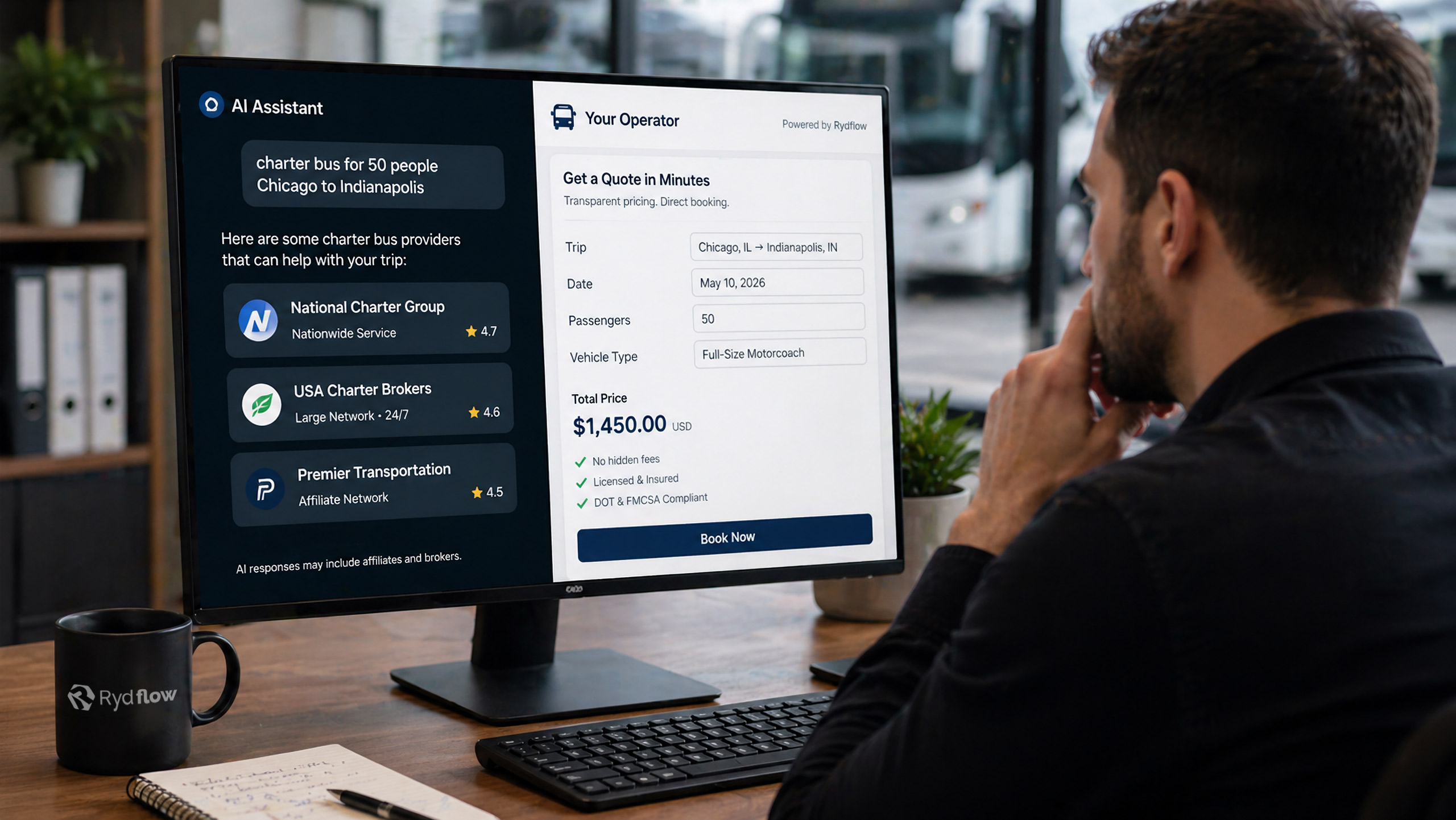
Last quarter, a customer typed “charter bus for 50 people Chicago to Indianapolis” into ChatGPT. The answer they got didn’t include a single local operator — just three national broker names with affiliate networks. The customer clicked the first one. A bus moved that weekend. An operator got a subcontracted job at thinner margins. The broker got the relationship.
This is the new shape of charter bus AI search, and it’s already costing operators direct bookings. The shift is happening fast enough that industry leaders — including Christian Riddell, CEO of TBN — have publicly warned that operators who don’t respond risk a trucking-style disintermediation, where the carriers do the work and a small group of intermediaries own the customer.
How charter bus AI search is rewriting the rules
Generative search engines — Google’s AI Overviews, ChatGPT, Perplexity, Claude — don’t behave like classic Google rankings. They synthesize answers from sources that are structured, authoritative, and easy for a language model to extract. Brokers have spent the last 18 months optimizing for exactly that: clean schema markup, FAQ-rich service pages, structured pricing data, and aggressive internal linking. Many independent operators have not.
The result: when a corporate planner or wedding coordinator asks an AI assistant for a coach quote, the AI surfaces the entity that *looks* most authoritative to a model — not necessarily the operator best equipped to run the trip. That’s almost always a broker or aggregator with national footprint and content depth.
For limo companies, the dynamic is even sharper. A high-net-worth client searching for “private chauffeur service for client meetings” is increasingly handed an aggregator name, who then dispatches to an underlying operator at compressed pricing.
What’s actually getting indexed (and what isn’t)
Generative search rewards three things, and most operator websites are weak on all three:
Structured service data. AI models pull from clearly-defined fleet pages, transparent pricing logic, and machine-readable trip information. A homepage that says “we serve the tri-state area” loses every time to a broker page that lists 47 specific cities, vehicle types, and capacity ranges in a structured table.
Trust signals. DOT numbers, FMCSA registration, insurance documentation, safety records, fleet age. Operators have all of this. Most don’t surface it on the public web in a way an AI can ingest.
Direct quote and booking pathways. AI assistants increasingly favor sources where the user can complete the action — get a quote, see live availability, book — without leaving the result. A “Call us for a quote” button is invisible to a generative search engine. A live quote widget is not.
Where Rydflow operators sit in this shift
Rydflow was built around the idea that operators should own the customer relationship — not surrender it to a broker layer. The platform gives operators the infrastructure that AI-driven search rewards:
A white-label booking widget that captures direct quote requests on the operator’s own domain, so the trip data and customer relationship stay with the operator. AI-ready quoting tools that produce structured, transparent pricing — exactly the kind of output generative search engines and modern buyers prefer over “request a callback.” A structured RFQ engine for when capacity is full, so operators never have to turn down a job and lose a customer to a broker just because they couldn’t run that one trip themselves.
The combination matters. Operators who can produce a quote in minutes, present transparent pricing, and handle overflow without subcontracting through a broker are the operators AI assistants will increasingly point traffic toward. The ones still quoting through email threads and turning down full-fleet days are the ones whose customers quietly migrate to a broker — and don’t come back.
Three moves operators should make this quarter
- Audit how your business currently appears to AI assistants. Ask ChatGPT, Perplexity, and Google’s AI Overview to recommend a charter bus or limo operator in your service area for a specific use case. If a broker name comes up before yours, you have your starting point. If your name doesn’t come up at all, you have a bigger problem.
- Restructure your service pages around extractable data. Vehicle types, capacities, service areas (named cities, not “the region”), pricing logic, response times, compliance credentials. Generative search engines feed on structured information. So do corporate buyers comparing vendors.
- Replace “Call us for a quote” with a real quoting pathway. Whether through Rydflow’s white-label booking widget or another route, the operators who win in AI search will be the ones who let a customer get a real number in real time. The ones who don’t will keep losing those customers to brokers who do.
What to do now
The disintermediation pattern is already well underway. The question is no longer whether AI search reshapes how charter bus and limo customers find operators — it’s whether operators position themselves to be found, or quietly become the back-end capacity that brokers monetize on top of.
Operators on Rydflow already have direct-booking infrastructure, a partner network for overflow, and structured trip data that generative search can actually surface. Operators still running on email threads, manual quotes, and a contact form have a narrowing window to catch up.
See Rydflow in action — book a 15-minute demo and we’ll show you exactly how it fits your operation.