
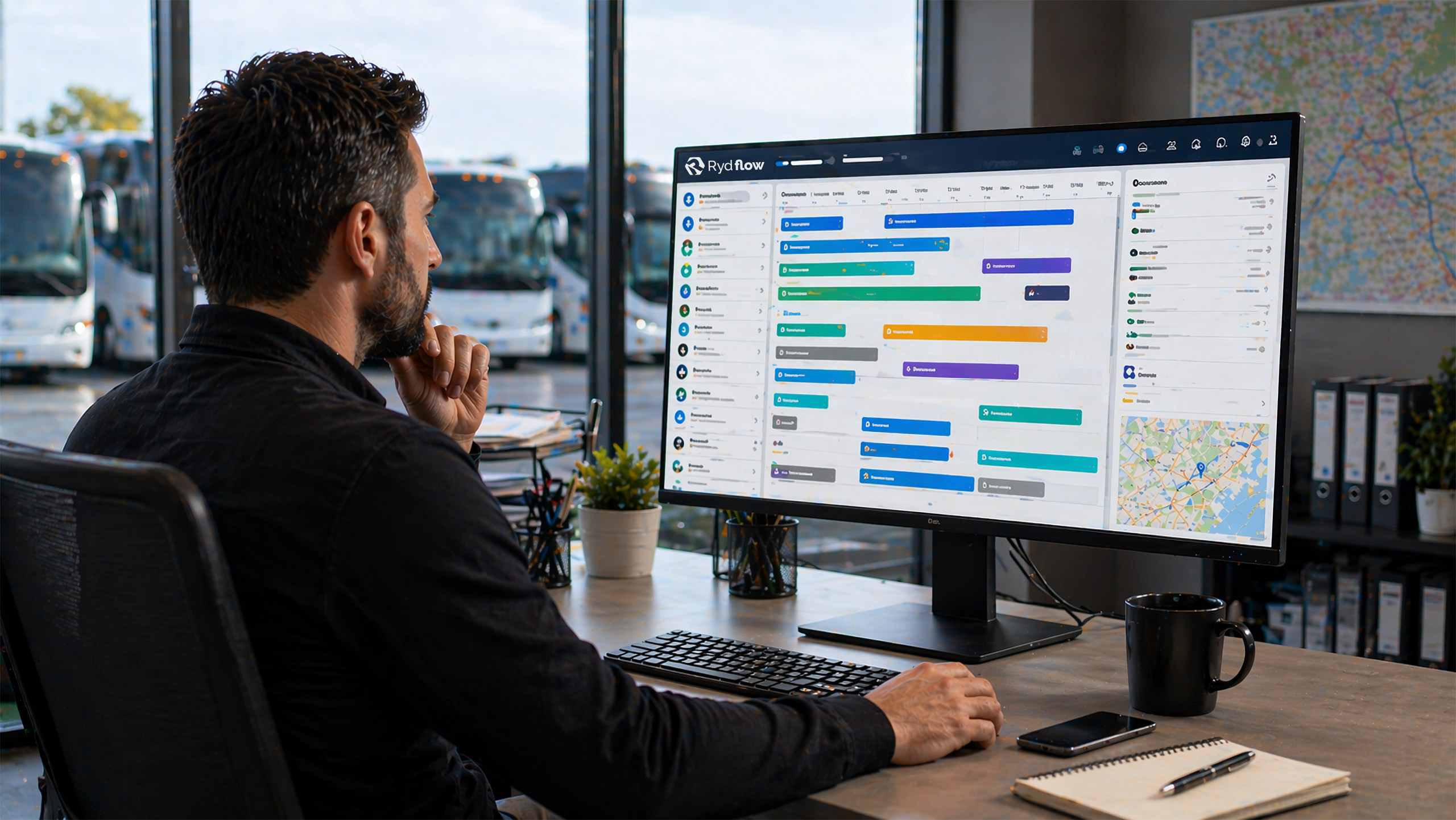
The software market for charter bus operators has gotten crowded. Platforms promising to manage your dispatch, simplify your bookings, and grow your business have multiplied — and the difference between them matters more than most operators realise before they sign up.
Some platforms are built for operators. Others are built around operators, extracting a cut of every job they facilitate. Before you commit to anything, it’s worth understanding which category you’re dealing with.
What Charter Bus Dispatch Software Actually Needs to Do
Strip away the marketing and charter bus dispatch software needs to do a small number of things reliably. It needs to manage your trip schedule without you maintaining a separate spreadsheet. It needs to assign vehicles and drivers without phone calls back and forth. It needs to give your team visibility into what’s running, what’s confirmed, and what’s pending — in one place.
Beyond that core, operators generally need quoting tools that produce professional outputs fast, invoicing that doesn’t require a separate accounting package for every job, and compliance document management that doesn’t live in a filing cabinet or a folder of email attachments.
These aren’t complex requirements. The problem is that many platforms either handle one piece well and others poorly, or they bundle everything into a system so complicated that adoption falls apart within the first month.
The other problem — and this is the one that costs operators real money — is the fee structure underneath the platform.
The Per-Booking Model and What It’s Actually Costing You
A significant number of platforms in the ground transportation space charge operators per booking, per quote, or take a percentage of the job value. This is sometimes framed as a low upfront cost. In practice, it’s a margin tax on every piece of revenue your business generates.
Run the numbers on a mid-volume operation. If you’re doing 40 to 60 bookings a month at an average fare of $1,200, and the platform takes 3% of each, you’re writing a check for $1,400 to $2,200 every month — before you’ve paid a driver, fueled a vehicle, or covered insurance. Scale up and the number scales with it.
The per-booking model makes sense for platforms that are generating demand for you — marketplaces where the platform is sending you jobs you wouldn’t otherwise have. If you’re bringing your own clients to a platform that then charges you for the privilege of servicing them, the economics are harder to justify.
The alternative is a flat monthly subscription: a fixed operating cost that doesn’t grow when your revenue does. For operators running an established book of business, this is a straightforwardly better deal.
Dispatch Features That Actually Matter in the Field
Most dispatch software demos well. The question is how it performs when a driver calls in sick at 6am and you need to reassign three vehicles across two jobs before the first pickup.
The features that matter in those moments are specific. Real-time visibility into driver and vehicle availability. Fast job reassignment without rebuilding the whole booking from scratch. Driver communication that doesn’t depend on personal phone numbers. A record of what changed, when, and who made the change.
Audit trails matter more than operators expect until the moment they need one. A client disputes a pickup time. An insurer asks about a specific trip. A driver claims they weren’t briefed on a route change. If your dispatch system can’t produce a clean record of the job as it was managed, you’re working from memory — which is rarely enough.
Integration With the Rest of Your Operation
Dispatch doesn’t exist in isolation. A job enters your system as a quote, becomes a booking, gets dispatched, gets invoiced, and generates a payment. If those stages live in different systems — quoting in email, dispatch in one platform, invoicing in another — the hand-offs between them are where things go wrong.
Errors in invoicing that trace back to dispatch notes. Bookings that were confirmed verbally but never entered properly. Compliance documents that weren’t checked because the booking and the vendor management system aren’t connected.
The strongest argument for an integrated platform isn’t efficiency. It’s error reduction. Every manual hand-off between systems is a point of failure. Operators who’ve consolidated onto a single platform consistently report fewer disputes, fewer missed details, and less time spent reconciling information across tools.
What to Ask Before You Sign Up
Before committing to any charter bus dispatch software, four questions cut through most of the noise.
First: what does the platform charge per booking, per quote, or as a percentage of job value? If the answer isn’t zero, model out what that looks like at your current volume — and at double your current volume.
Second: can you see a demo with your actual workflows, not a scripted walkthrough? Any platform worth using should be able to show you how a same-day reassignment works, not just how a standard booking looks on a good day.
Third: where does your data live, and what happens to it if you leave? Operators have been caught out by platforms that make data export difficult or charge for it. Your booking history, your client records, your compliance documents — that’s your business data. You should be able to take it with you.
Fourth: what does the support structure look like? In ground transportation, problems don’t wait for business hours. Knowing whether support is available when you need it — and at what response time — is worth establishing before you’re the one with a live dispatch issue and no one answering.
See Rydflow in action — book a 15-minute demo and we’ll show you exactly how it fits your operation.