
Your fleet is fully booked. The phone rings. It’s a solid job — good margin, reliable client — and you have to turn it down. You hang up knowing that call probably goes straight to a competitor.
This happens to charter bus operators every week. And unlike a lost tender or a price negotiation gone sideways, it’s entirely avoidable.
The Real Cost of a Full Fleet
A fully booked fleet sounds like a good problem to have. In reality, it has a hard ceiling that most operators hit faster than they expect — particularly during peak season, around major events, or when corporate accounts start moving in volume.
The instinct is to say no and move on. But the revenue lost to a single turned-down job isn’t just the fare. It’s the relationship. Clients who get told no often don’t call back. They find someone who said yes, and if that operator does a decent job, the account is gone.
For operators running five to twenty vehicles, the math on overflow is significant. A mid-size coach job in a US metro market can run anywhere from $800 to $3,000 depending on duration and vehicle type. Turn down two or three of those a month and you’re leaving $20,000 to $30,000 a year on the table — jobs your fleet could have handled if you’d had one more vehicle available that day.
The problem isn’t capacity. It’s the absence of a reliable way to fulfill jobs when capacity runs out.
Why Most Operators Don’t Subcontract — And Why That’s Changing
Subcontracting has a reputation problem in the charter industry. Operators who’ve tried it informally — a WhatsApp message to another local company, a handshake deal with someone they met at a trade show — know it can go wrong quickly. The subcontractor turns up late. The vehicle isn’t what was described. The client calls you to complain about someone else’s driver.
The result is that many operators would rather turn down the job than risk their reputation on a vendor they can’t vouch for.
That logic is understandable. It’s also holding operators back.
The difference between informal subcontracting and a structured partner network is accountability. When you’re working with operators you’ve vetted, whose compliance documents are on file, and whose vehicles you know, the risk profile changes entirely. You’re not farming a job out to a stranger — you’re extending your operation through a trusted network.
This is exactly how the largest ground transportation companies in the US handle capacity. They don’t own every vehicle they fulfil. They have relationships, and those relationships are managed through systems rather than text threads.
What a Partner Network Actually Looks Like
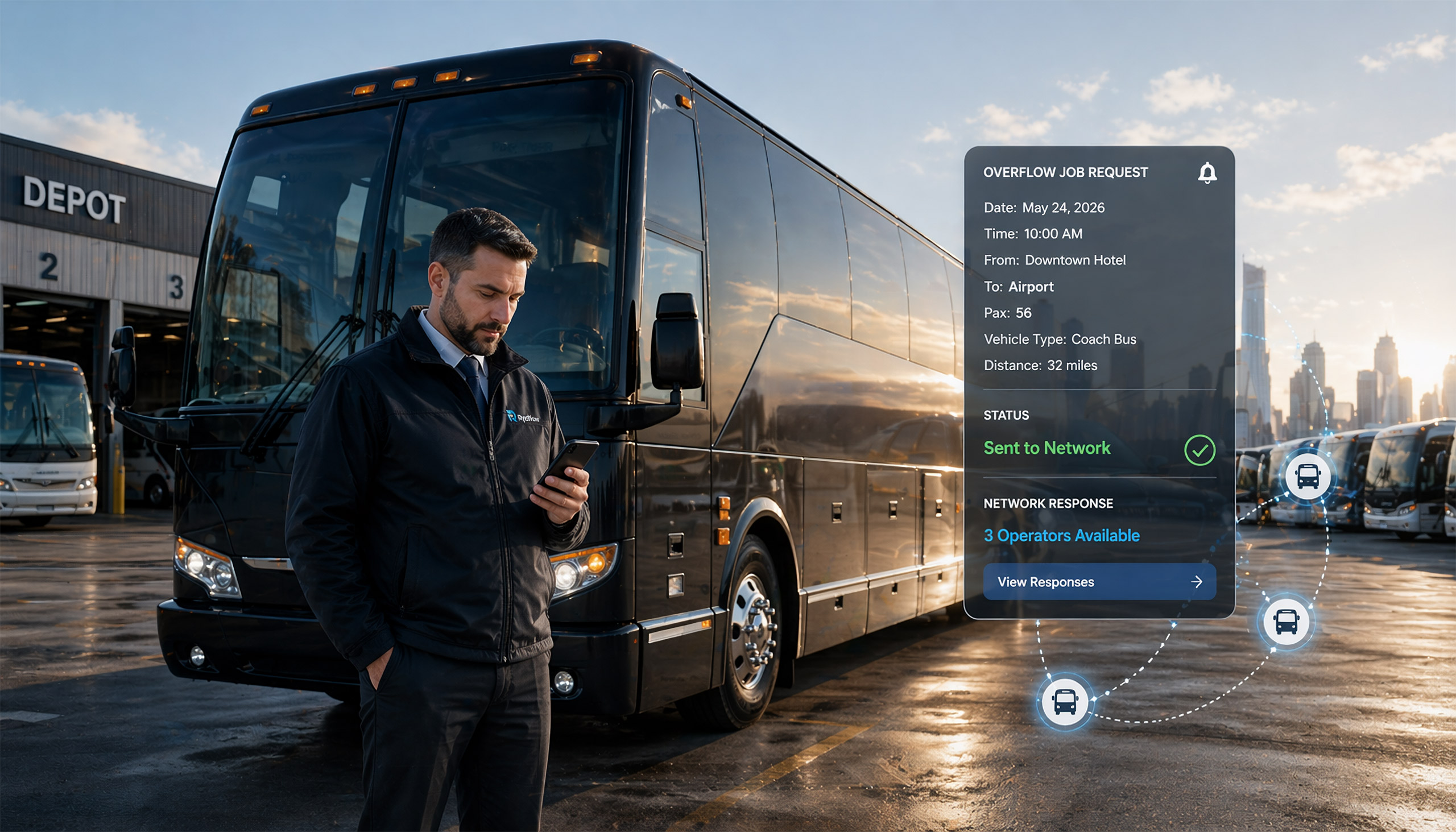
An operator-to-operator RFQ network works simply: when you have a job you can’t cover, you send a request to your network. Operators in your network who have availability respond with a quote. You review, confirm, and the job gets covered — under your name, with your client.
The client experience doesn’t change. Your relationship with that client doesn’t change. What changes is that instead of saying no, you’re saying yes and managing the fulfilment behind the scenes.
For this to work reliably, a few things need to be in place. You need visibility into which operators in your network are available and what they’re running. You need compliance documentation — insurance, licences, safety records — accessible without chasing it down by email. And you need the job handoff to be clean: the right details, confirmed in writing, with no ambiguity about who’s responsible for what.
When those elements are in place, overflow stops being a liability and starts being a revenue stream.
The Operators Already Doing This
The charter operators growing consistently in competitive markets aren’t necessarily the ones with the biggest fleets. They’re the ones who’ve built networks that let them say yes more often than their competitors.
Some of this happens through informal relationships built over years. But increasingly, operators are building these networks deliberately — identifying trusted partners in adjacent markets, overlapping service areas, or complementary vehicle types, and creating the systems to activate those partnerships quickly when demand spikes.
A limo company that’s built a relationship with a coach operator doesn’t just have a fallback for the nights the sedans are all out. It has a way to take group bookings it would otherwise have to decline — and a referral relationship that flows in both directions.
The operators who get this right don’t think about their fleet size. They think about their network size.
Turning Overflow Into an Asset
The structural change required here isn’t large. It’s not a new vehicle purchase or a staff hire. It’s a process change: moving from “we’re fully booked” to “let me check with my network.”
That process change needs two things. First, the right partners — operators you trust, whose standards match yours. Second, a system that makes activating those partners fast enough to be practical. If it takes three phone calls and a back-and-forth email chain to confirm an overflow job, you’ll stop doing it after the first bad experience.
The operators getting the most value from partner networks are the ones who’ve made the process frictionless. A job comes in, capacity is checked, a request goes out, a confirmation comes back. The whole thing happens in minutes, not hours.
That’s the difference between overflow being an occasional workaround and overflow being a consistent line of revenue.
Ready to stop turning down jobs when your fleet is full? Start your free Rydflow trial — no commission, no per-job fees. Just your bookings, your revenue.