
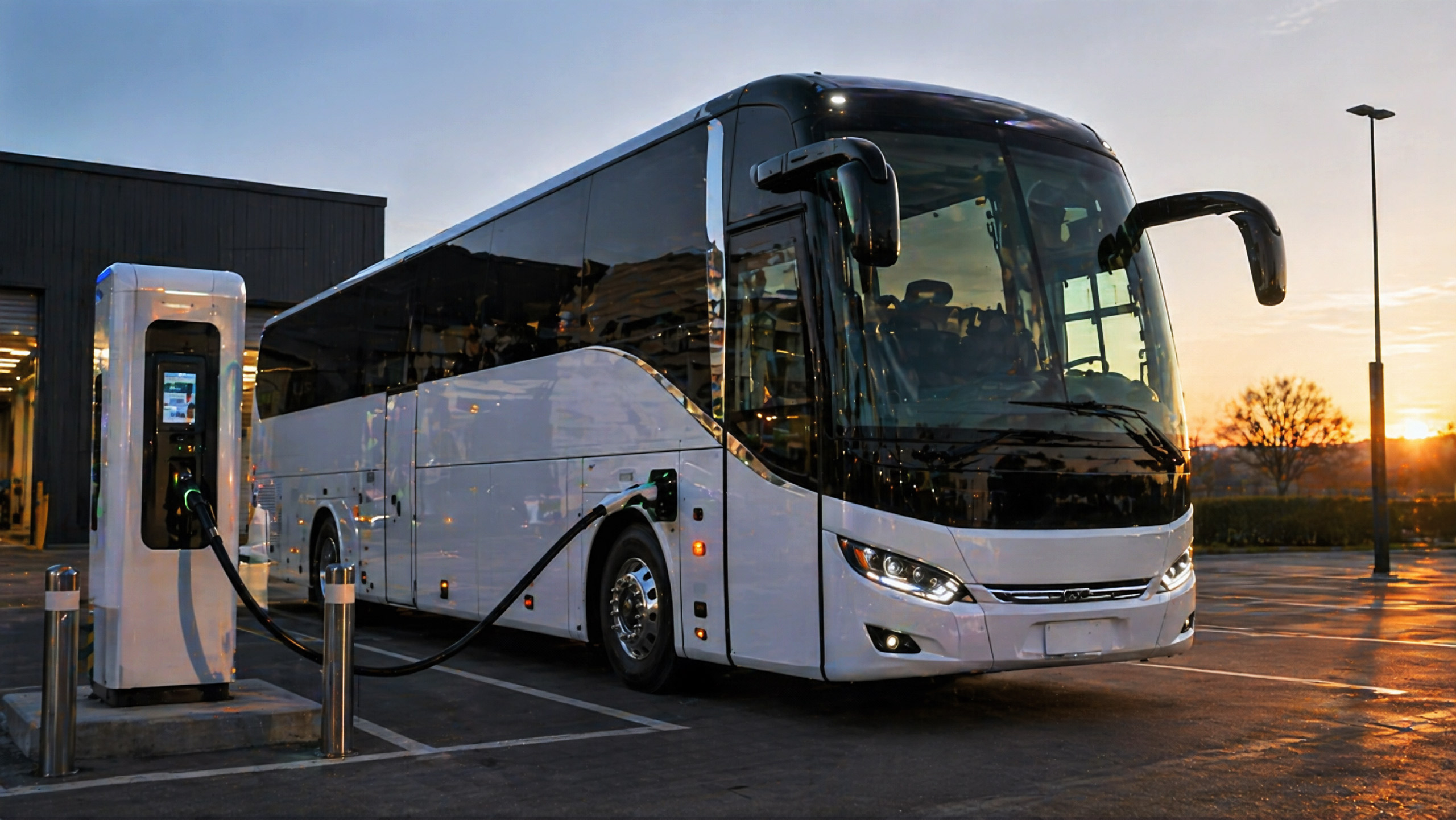
A 56-passenger battery-electric coach can run a 180-mile day-trip charter, recharge overnight at a depot, and post a per-mile operating cost roughly 30% below diesel. The same coach, asked to run a 600-mile intercity route with one mid-day stop, becomes an operational liability — limited corridor charging, range anxiety on grade-heavy routes, and a duty cycle the battery can’t reasonably support without a route redesign.
This is the actual state of coach electrification 2026: not a binary “electric vs. diesel” decision, but a route-by-route, depot-by-depot evaluation that some operators are getting right and others are spending seven figures getting wrong. The Busworld Europe Socio-Economic Insights Report, released in April 2026, put it bluntly — electrification of urban transit is irreversible, but for long-distance coach service “diesel is still expected to dominate this segment by the end of the decade.” For operators trying to decide where to deploy capital, the question isn’t whether to electrify. It’s where.
Why coach electrification 2026 looks different from transit
Transit buses run predictable, short, fixed routes with depot-based overnight charging — almost ideal conditions for battery-electric operation. Coach operations don’t share any of those characteristics.
A charter coach’s duty cycle is unpredictable: a wedding shuttle one day, a casino run the next, a multi-day tour the day after. Routes can be 80 miles or 800. Layovers happen at venues, not depots. Customers expect on-time pickups regardless of charging-infrastructure availability at the destination.
Battery technology has improved meaningfully — energy density gains and falling per-kWh costs have moved total-cost-of-ownership parity closer for some duty cycles — but the operational profile of a charter coach still pushes against the technology’s limits. A diesel coach starts the day with a full tank and refuels in 15 minutes. An electric coach starts the day with a full battery and needs structured charging access throughout its route. For some routes, that’s solvable. For others, it’s the difference between a viable contract and a missed pickup.
The four route types and how they score for electrification
Operators evaluating fleet electrification should categorize their routes into four buckets — and the answer is different for each.
Type 1: Urban and short-suburban charters (under 150 miles, depot-based).
Strong candidates. Wedding shuttles, school field trips inside a single county, corporate event transport, sports team transfers within a metro area. A modern battery-electric coach handles these comfortably with overnight depot charging and no route compromises. Operating cost savings are real, maintenance is simpler (no engine, no transmission, no DEF), and the customer-facing pitch (“we run an emissions-free fleet for your event”) increasingly wins corporate and ESG-driven contracts.
Type 2: Regional day-trip charters (150–300 miles, return-to-depot).
Conditional. Day-trip casino runs, sightseeing tours that return to the operator’s yard, regional sports transport. Viable with current battery technology if the operator runs the math on route grades, weather (cold weather drops range 20–30%), HVAC load on full coaches, and depot charging speed. A 300-mile day with full passenger load and air conditioning in July is at the upper edge of what most current electric coaches handle without intermediate charging.
Type 3: Intercity scheduled service (300–600 miles, multi-stop).
Difficult. Currently requires either route-specific charging infrastructure built along the corridor, or a hybrid approach where electric coaches handle one segment and diesel handles others. A handful of corridors in the Northeast and California have enough corridor charging to make this work; most don’t. Operators looking at this segment should be conservative — the infrastructure typically isn’t there yet.
Type 4: Long-haul charter and tour (600+ miles, multi-day).
Stay diesel for now. Multi-day national tours, cross-country charters, long-distance team travel. The combination of route unpredictability, layover variability, and infrastructure gaps makes electrification operationally impractical with current technology. The Busworld report’s projection that diesel will dominate this segment through the end of the decade is realistic.
What the math actually looks like
For a Type 1 route — a 56-passenger coach running 180 miles a day, six days a week, 50 weeks a year — the operating-cost gap between electric and diesel runs roughly $0.85/mile vs. $1.20/mile, all-in. That’s $54,000 a year in operating savings on a single coach. Over a typical seven-year coach lifecycle, the cumulative savings can offset most of the upfront price premium of an electric coach (currently $200,000–$350,000 over diesel, depending on configuration and federal/state incentives).
For a Type 4 route, the math doesn’t work — even if the electric coach were free. Range constraints turn a 12-hour single-driver day into a 16-hour day with mandatory charging stops, which violates DOT hours-of-service rules without splitting the trip across two drivers. Operating cost savings disappear under additional labor costs.
The operators who are getting electrification right in 2026 are the ones running the math at this granular level — by route, by season, by load factor — instead of running it at the fleet level.
Where dispatch software fits the electrification decision
Selective electrification only works if the operator can route the right vehicle to the right job. Sending an electric coach on a 600-mile tour because dispatch didn’t see the charging-infrastructure gap is exactly how operators turn a smart capital decision into an expensive operational failure.
Modern coach dispatch software — including Rydflow’s trip management and dispatch tools — lets operators tag vehicles by range capability, charging requirements, and route compatibility. When a quote comes in for a 180-mile charter, the electric coach is the obvious assignment. When a 700-mile tour books, the diesel coach is. The decision happens at quote time, not at 6am the morning of the trip when a dispatcher is improvising.
For operators running mixed fleets — which is what most successful electrification looks like for the next five years — this kind of vehicle-aware dispatch is the difference between capturing the operating-cost savings and losing them to mismatched assignments.
What to do now
Coach electrification 2026 is a route-selection problem, not a fleet decision. The operators who will benefit most over the next 24 months are the ones who pilot electric coaches on Type 1 and Type 2 routes, keep diesel for Type 3 and Type 4, and use dispatch software that respects the difference. The operators who buy electric coaches and assign them randomly will produce stranded capital, missed pickups, and a CFO with regrets.
The technology will keep improving. Corridor charging will expand. Battery density will rise. By 2030, the route map for viable electrification will look meaningfully different. But for fleet decisions made this year, the framework is clear: electrify the routes that the technology actually fits, and let diesel keep running the ones it doesn’t.
See Rydflow in action — book a 15-minute demo and we’ll show you exactly how vehicle-aware dispatch works for mixed fleets.