
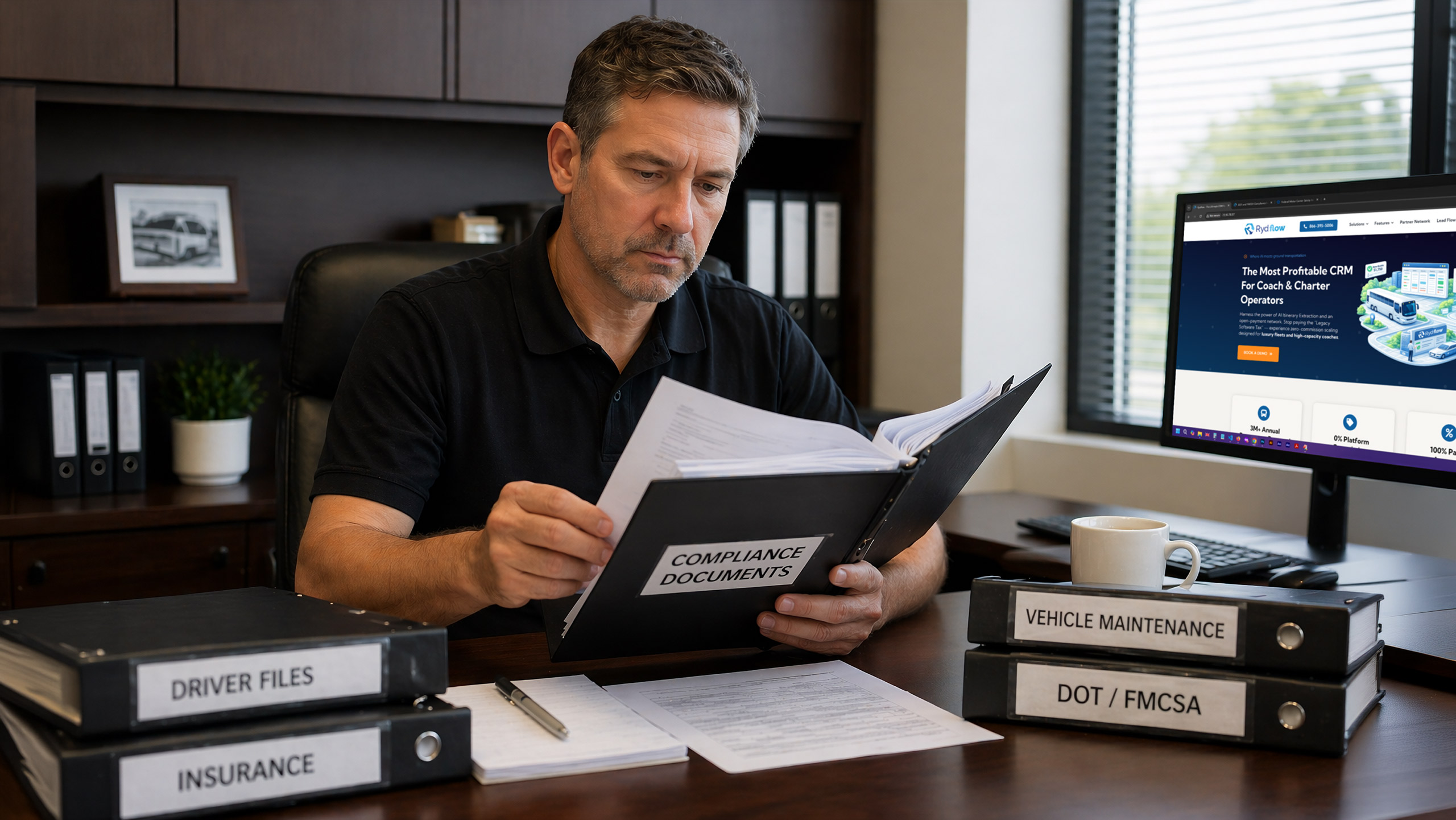
Compliance in the charter bus industry is one of those areas where the consequences of getting it wrong arrive suddenly and without much warning. An audit, an incident, a client running due diligence before signing a contract — and the question becomes whether your records are in order or whether you’re scrambling to find documents you’re not entirely sure are current.
For operators who’ve been in the business long enough, compliance management has a way of accumulating debt. The filing system that made sense with five vehicles gets unwieldy at fifteen. Documents get renewed and stored in different places. Someone leaves and takes institutional knowledge with them. The result isn’t outright non-compliance — it’s a grey zone where things are probably fine until they aren’t.
This post covers what charter operators are required to maintain under FMCSA and DOT regulations, where compliance programmes most commonly fall short, and how to get to a point where your records are audit-ready without it consuming significant management time.
Operating Authority and Registration
The starting point for any charter carrier operating in interstate commerce is FMCSA operating authority — the MC number that establishes your right to operate as a for-hire carrier. This isn’t a one-time registration. The conditions attached to it require ongoing compliance, and your operating authority can be revoked for failure to maintain insurance filings or safety fitness standards.
Carriers are required to keep their Unified Registration System (URS) records current, including any changes to ownership, principal place of business, or operating area. Changes that aren’t updated promptly create discrepancies that surface during audits.
For operators working exclusively within a single state, state-level authority requirements apply rather than FMCSA federal authority — but the documentation obligations are comparable and often mirror the federal framework.
Insurance Requirements and What Must Be on File
FMCSA insurance requirements for passenger carriers specify minimum liability coverage based on vehicle seating capacity. For vehicles with more than fifteen passengers (including the driver), the minimum is $5 million in liability coverage for most interstate operations — though specific requirements vary based on route type and whether hazardous materials are involved.
What matters operationally is not just carrying the required coverage, but maintaining proof of that coverage in a form that can be produced on request. FMCSA requires insurance to be filed directly with the agency via an MCS-90 endorsement, not just held by the operator. An insurance renewal that isn’t re-filed with FMCSA is a gap in your compliance record even if the underlying policy is current.
Operators working with subcontractors or network partners need to maintain insurance certificates for those operators as well. If you’re putting another company’s vehicle and driver in front of your client, their insurance needs to be verified and on file — not just assumed.
Driver Qualification Files
FMCSA regulations require carriers to maintain a driver qualification file for every commercial driver. The contents of that file are specified and include the driver’s employment application, road test certificate or equivalent, motor vehicle record checks (from every state where the driver has held a licence in the past three years), annual review of driving record, and medical examiner’s certificate.
The annual driving record review is the component most commonly left to slip. It’s easy to complete the initial hire documentation thoroughly and then let the annual review cycle drift — particularly in operations where drivers are long-term employees and the review feels like a formality. Regulators don’t treat it as one.
Commercial drivers are also required to hold a valid commercial driver’s licence (CDL) with a passenger (P) endorsement. The CDL with school bus (S) endorsement is required separately for drivers operating school buses, which is relevant for operators running school district contracts.
Medical certificates are time-limited — typically two years for drivers who meet standard criteria, less for those with certain medical conditions. Tracking expiry dates manually across a driver fleet is where compliance programmes break down most reliably.
Vehicle Maintenance Records
FMCSA requires carriers to maintain systematic inspection, repair, and maintenance records for every vehicle in the fleet. The regulation (49 CFR Part 396) specifies that records must be kept for each vehicle, must cover all inspections and repairs, and must be retained for a defined period.
Annual vehicle inspections by a qualified inspector are required, and the inspection report must be kept on file. Drivers are required to conduct pre-trip and post-trip inspections and to report any defects. Those defect reports, and the repair records responding to them, need to be retained.
The practical challenge isn’t doing the maintenance — most operators maintain their vehicles properly because the alternative is breakdowns. The challenge is the documentation trail. A maintenance log that lives in a workshop notebook doesn’t meet the requirement for systematic record-keeping. It needs to be organised, searchable, and producible on demand.
Hours of Service
The FMCSA hours of service regulations apply to commercial passenger carriers and limit driving time to 10 hours following 8 consecutive hours off duty. Drivers are prohibited from driving after being on duty for 15 hours.
Electronic logging devices (ELDs) are required for most commercial carriers, with limited exceptions. For charter operators who were managing hours of service through paper logs, the ELD mandate changed the compliance picture significantly — ELD records are more precise, more auditable, and harder to retroactively adjust than paper records.
The hours of service rules create operational constraints that experienced charter operators know well. Where compliance issues arise is typically in record-keeping hygiene: logs that aren’t completed correctly, ELD malfunctions that aren’t addressed promptly, or on-duty time that isn’t being recorded accurately across all activities.
Building a System That Stays Current
The operators with the cleanest compliance records aren’t necessarily the most diligent — they’re the ones who’ve built systems that make compliance maintenance automatic rather than effortful.
That means expiry-date tracking for insurance certificates, medical certificates, and vehicle inspections. It means driver qualification file checklists that flag gaps rather than relying on someone to remember what’s due. It means document storage that’s accessible to the people who need it — a dispatcher pulling a subcontractor’s insurance certificate before a job, a manager responding to a client audit request — without a manual search through email archives.
The investment in building that system pays back quickly. An hour of time recovered per week across a fleet of ten vehicles adds up. An audit that produces clean documentation rather than a multi-day scramble is a different kind of return — one that’s harder to quantify until you’ve experienced the alternative.
Managing compliance documents across your operation? See how Rydflow handles it — document storage, expiry tracking, and driver records in one place. Book a demo to see it in your workflow.