
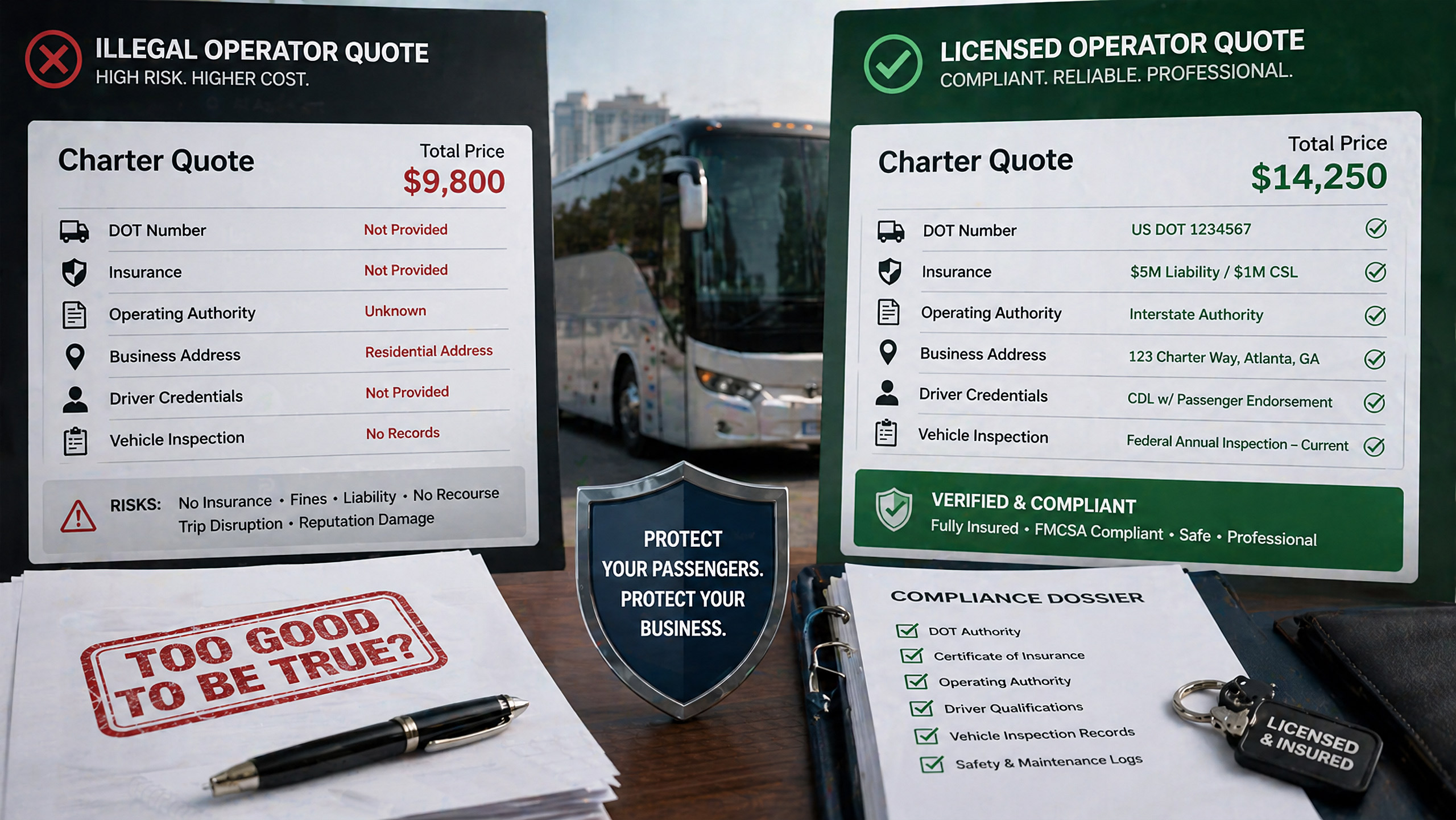
A corporate planner in Atlanta requested quotes for a 54-passenger coach for a three-day client retreat. Six bids came in. Three were 30% below the going rate. One had no DOT number on the vehicle photo. Another listed an address that turned out to be a residential apartment. The lowest bid won — and a licensed operator across town lost a $14,000 contract to a company that, by every legal definition, shouldn’t have been on the road.
This is the daily reality of competing against illegal charter bus operators. The National Limousine Association called illegal operators one of the top three threats to the industry at the 2026 CD/NLA Show in Las Vegas — alongside the insurance crisis and autonomous vehicles. For licensed coach and limo companies, every illegal bid distorts pricing, depresses margins, and routes customers to vehicles that may not be insured, inspected, or driven by a properly licensed operator.
What “illegal operator” actually means
The term is broader than most planners realize. An illegal charter bus or limo operator typically falls into one of four categories:
No DOT or FMCSA authority. Federal law requires interstate passenger carriers to hold operating authority through the FMCSA. Plenty of bidders advertise charter services with no DOT number and no intent to get one.
Lapsed or insufficient insurance. Federal minimums for passenger carriers are well-defined, but enforcement is inconsistent. An operator with expired or below-minimum insurance is one accident away from leaving 50 passengers and a planner with no recourse.
Improper driver licensing. A commercial driver’s license with a passenger endorsement is non-negotiable for vehicles above certain capacities. Illegal operators routinely use drivers without the right endorsements — a fact that doesn’t show up on a quote sheet.
Vehicle inspection and registration gaps. State and federal annual inspections, current registration, valid for-hire markings. Skipping any of these saves an illegal operator roughly $4,000–$8,000 a year in compliance costs — which is exactly how they underbid licensed competitors.
How illegal charter bus operators win bids they shouldn’t
The economics are straightforward. A licensed operator carries insurance premiums that have risen 20% in 2026 even with a clean record, plus DOT compliance overhead, driver background checks, drug and alcohol testing programs, and vehicle inspection schedules. An illegal operator carries none of those costs. The result: they can bid 25–40% under market and still take a margin.
Corporate planners and event coordinators who don’t know what to look for see the lowest number, accept it, and move on. The risk surfaces only when something goes wrong — a breakdown, an accident, a no-show — and the planner discovers their “vendor” has no real business address, no insurance contact, and no answer when the phone rings on a Saturday night.
The vetting checklist for buyers
Whether the buyer is a corporate event planner, a school district, a wedding coordinator, or a travel agent, the vetting process should be identical. A legitimate charter bus or limo operator will produce all of the following without hesitation:
Active DOT number with no out-of-service status. Verifiable on the FMCSA’s public SAFER system. Any operator who can’t or won’t share their DOT number is disqualified.
Certificate of insurance naming the buyer or event. Issued by a real insurance carrier, with current dates and coverage limits at or above federal minimums for passenger transport.
For-hire authority appropriate to the trip. Interstate trips require interstate authority. Intrastate trips require state-level credentials. Operators who can’t articulate the difference probably don’t hold the right ones.
A physical business address. Not a UPS Store, not a residential address. A real operating yard or office.
Driver qualification documentation on request. CDL with passenger endorsement, clean driving record, current medical certification, current drug and alcohol program enrollment.
Vehicle inspection records. Annual federal inspections, current state registration, recent maintenance logs.
If a bid is 25% below the rest of the field and the operator can’t produce the above within 24 hours, the buyer is looking at an illegal operator.
How licensed operators can compete — and win — on more than price
Licensed charter bus and limo operators don’t lose to illegal bidders because their service is worse. They lose because the buyer doesn’t know what they’re comparing. The fix is to make the comparison impossible to ignore.
Lead with compliance, not with rate. Quotes that include DOT number, insurance summary, driver credentials, and inspection status — surfaced on the quote itself, not buried in a follow-up email — reframe the bid from a price comparison to a risk comparison. The illegal operator can match the price. They can’t match the documentation.
Centralize compliance documents so you can produce them on demand. This is where Rydflow operators have a structural advantage. The platform’s compliance document management surfaces certificates, DOT credentials, and insurance certificates against every quote the operator sends — so the buyer sees the full picture at the moment of decision, not after the contract is lost. For school districts and corporate buyers running formal vetting processes, this alone closes deals.
Educate the buyer in the proposal itself. A short paragraph in the quote explaining what to verify (“Before booking any charter bus operator, confirm an active DOT number, current insurance certificate, and CDL passenger-endorsed drivers — we’ve included ours below”) does more to win the bid than a 10% rate cut. It also signals professionalism that illegal operators can’t fake.
What to do now
Illegal operators aren’t going away. Insurance pressure, slow regulatory enforcement, and AI-driven search results that don’t filter for compliance all favor the unlicensed competitor in the short term. The licensed operators who win the next 24 months will be the ones who stop competing on price and start competing on transparency — making it impossible for a serious buyer to pick an illegal bid without knowing exactly what they’re choosing.
For buyers, the lesson is simpler: lowest bid means nothing without verified credentials behind it. The cost of a $4,000 cheaper coach goes to six figures the moment something goes wrong on the road.
Ready to stop losing jobs to operators who shouldn’t be on the road? Start your free Rydflow trial — no commission, no per-job fees. Just your bookings, your revenue, your compliance documentation in front of every buyer.