
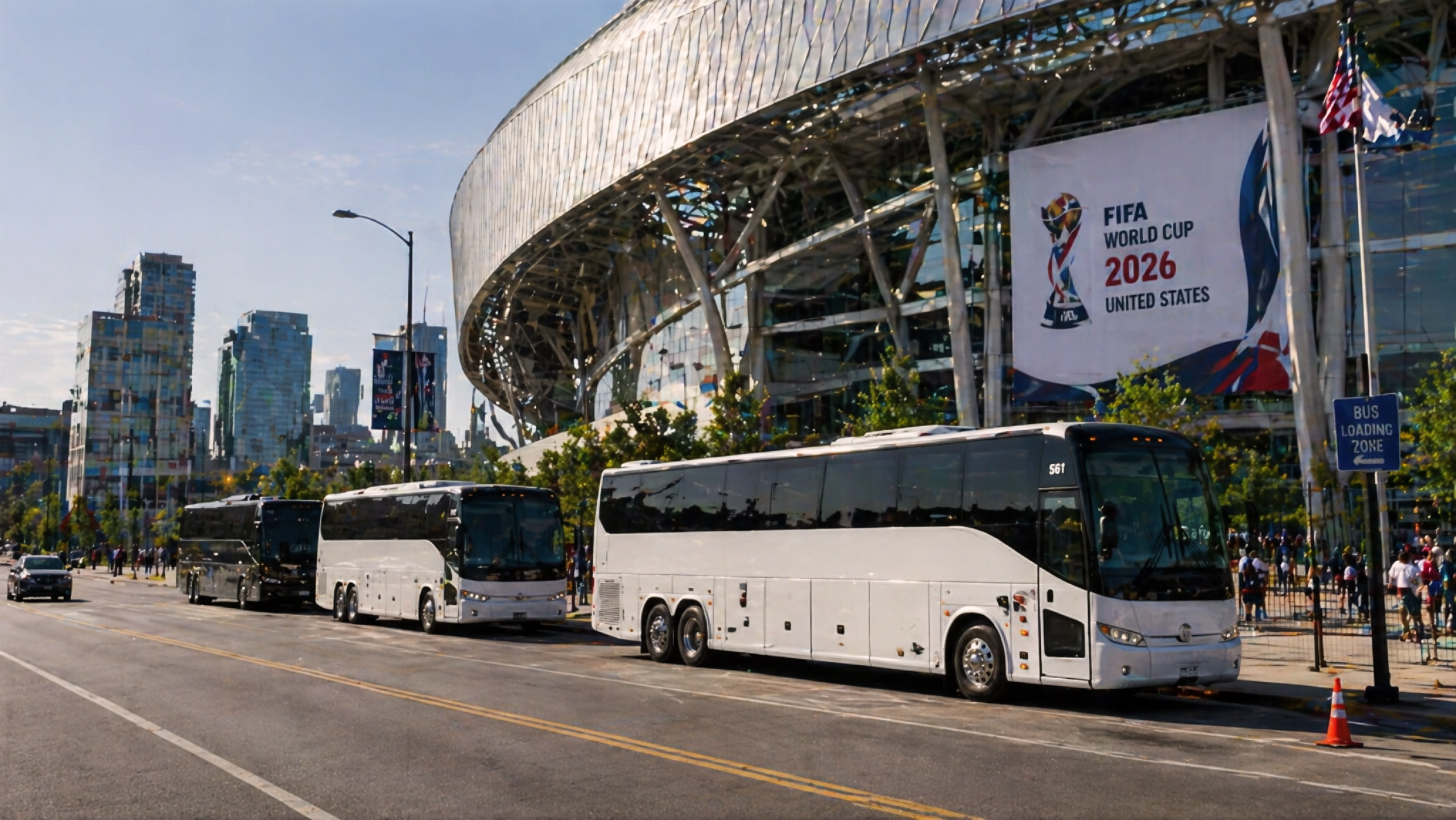
The 2026 FIFA World Cup will move more international ground passengers across the United States than any single event in the country’s history. Sixteen host cities. Forty-eight competing nations. Tens of thousands of fans planning multi-city itineraries — Boston to Philadelphia, New York to Atlanta, Dallas to Kansas City — across a six-week tournament window. The Northeast corridor alone is already showing the heaviest pre-booking pressure, with intercity charter capacity tightening twelve months out from kickoff.
For US charter bus operators, World Cup 2026 charter bus demand is not a single event. It’s a sustained, multi-city, multi-week capacity stress test that will separate operators with structured overflow management from operators still running on a spreadsheet and a phone. The ones who navigate it well will book the next World Cup in 2030, the 2028 LA Olympics, and a decade of corporate group transport built on the relationships they secured during the tournament. The ones who don’t will spend July 2026 turning down jobs they couldn’t fulfill.
Why World Cup 2026 charter bus demand is structurally different
A typical US summer charter season is regional. Operators in New Jersey serve the New Jersey market; operators in Texas serve Texas. World Cup demand breaks that pattern entirely.
Fans don’t follow regional logic — they follow their team’s match schedule. A Mexican fan flying into Dallas for a group-stage match may charter onward to Kansas City for the next, and Houston for the third. A German tour group may move from Boston to Philadelphia to MetLife. Each leg is a charter request, often booked by a single tour operator or sports travel agency consolidating passengers across multiple nationalities.
The result is sustained demand in intercity corridors that don’t normally see this kind of pressure: Boston–New York, New York–Philadelphia, Dallas–Houston, LA–San Francisco, Atlanta–Miami. Operators who own capacity in these corridors will field bid requests far above their fleet’s daily capacity. Operators who don’t will get inquiries from sports travel agencies and tour operators who picked their name off Google or an AI search result, expecting them to deliver — even if they’re a single-yard operation with eight coaches.
The capacity problem nobody is talking about
Most US charter bus operators run between 5 and 25 coaches. A single match day in a host city can absorb 200+ coach-equivalents in shuttle, charter, and team-transport demand. The math is unforgiving: every operator in every host city will be capacity-constrained on match days. Many will be capacity-constrained on travel days between matches.
The operators who turn this into revenue rather than missed bookings are the ones who treat overflow as a managed workflow, not an exception. That means three things:
Knowing exactly when you’re full, in real time. A dispatcher who can’t answer “what’s our committed coach utilization on July 14?” in under 30 seconds is going to overbook or under-book. Both lose money.
Having a partner network ready before the inquiry arrives. Operators who try to find subcontracting partners *during* a 50-coach inquiry are negotiating from weakness. Operators who already have a vetted, pre-negotiated network can route overflow within hours and capture the full booking instead of declining half of it.
Quoting fast enough to win the bid. A sports travel agency sending RFQs to twelve operators across a corridor will book with whoever quotes first, with credible documentation, at acceptable pricing. Slow quoters lose. Operators still building quotes manually in email threads will get crushed by operators quoting in minutes.
How RFQ networks change the calculus
Rydflow operators handle the overflow problem differently. The platform’s structured RFQ engine lets an operator who’s full route a request to other operators in their network — operator-to-operator, not buyer-facing — and confirm subcontracted capacity without losing the customer relationship. The buyer continues to deal with one operator. The trip gets fulfilled. The original operator earns the management fee and keeps the corporate or agency relationship intact for the next booking.
For World Cup 2026, this matters disproportionately. A charter operator in Philadelphia who receives a 30-coach inquiry from a German tour operator can fulfill 12 coaches from their own fleet, route 18 to partner operators via Rydflow’s RFQ engine, and present a single confirmed quote in hours. The alternative — turning down 18 coaches’ worth of business or scrambling through phone calls and group chats to find subcontractors — costs both the immediate revenue and the long-term relationship with a tour operator that will book the 2028 Olympics, the 2030 World Cup, and every German group-tour itinerary in between.
Three moves operators should make before March 2026
- Audit your dispatch and quoting speed now. Time the gap between a quote inquiry arriving and a quote going out. If it’s longer than two hours for standard charter requests, World Cup volume will crush you. Fix it before the inquiries start landing.
- Build your overflow network before you need it. Identify operators in your corridor with compatible service standards. Confirm pricing structures and subcontracting terms in advance. The operators you partner with in March will be the ones running your overflow in July.
- Get your compliance documentation ready to attach to every quote. International tour operators and sports travel agencies vet vendors more carefully than domestic buyers. DOT credentials, insurance certificates, driver qualifications, fleet age — surfaced on the quote, not promised after award — will win bids that go to less-prepared competitors.
What to do now
World Cup 2026 will book most of its ground transportation capacity in the first quarter of the year. Operators who wait until April to think about it will find that the corporate, agency, and tour-operator contracts have already been awarded — to operators who were structurally ready three months earlier. There is no second chance to compete for tournament-window business once the bookings are placed.
The operators who win this tournament aren’t the ones with the largest fleets. They’re the ones with the fastest quotes, the cleanest compliance documentation, and the best-managed overflow networks. Fleet size matters. Operational readiness matters more.
Ready to stop losing jobs to capacity gaps? Start your free Rydflow trial — no commission, no per-job fees. Just your bookings, your revenue, your overflow handled.